Modular Puzzle Clicker Set (4-Key Customizable Clicker)
by wjddnjsdnd in Living > Toys & Games
292 Views, 5 Favorites, 0 Comments
Modular Puzzle Clicker Set (4-Key Customizable Clicker)

Clickers (fidget clickers) are great tools for helping children focus and relieve stress.
While making clickers as gifts for kids, I noticed a common limitation in most commercially available clickers:
👉 Their shape and layout are fixed.
No matter how you use them, the button arrangement is always the same.
To solve this, I designed a modular 4-key clicker set inspired by jigsaw puzzle shapes.
Each key module can be freely rearranged on the table, allowing layouts such as:
- Straight line
- T-shape
- Square
- L-shape
This makes the clicker more playful, interactive, and customizable.
The clicker is made from EVA foam, is lightweight and safe for kids, and can be easily reproduced using a laser cutter.
It also supports magnetic key stems and replaceable keycaps, so users can customize both feel and appearance.
Supplies
Laser Cutting the EVA Foam & Making the Key Housing
Use the provided SVG files to laser-cut the parts from 5mm thick EVA foam.
I cut with a 5W laser on a diode laser processing machine at an intensity of 30% and a speed of 1000. This was repeated a total of 7 times. From the 4th time, the z-axis was lowered by 1 mm and repeated 4 times.
You can freely choose colors to create your own style.
👉 Note:
This explanation is based on black Eva foam. Different colored materials need to be set at different intensities.
🔹 Key Housing Structure
Each key housing consists of two parts:
- Bottom piece (no hole) → base
- Top piece (with hole) → upper cover
🔹 Assembly
- On the bottom EVA piece, attach 10mm thick double-sided tape:
- Horizontally and vertically
- Very close to the edges
- Carefully align and attach the top piece.
- Insert the key switch.
The key switch is naturally held in place by the adhesive force of the double-sided tape, so no extra fixing parts are needed.
Downloads

Assembling the Puzzle-Style Key Modules

Now, create the puzzle-shaped housings that hold each key.
- This housing is also made of two identical EVA foam parts.
- Apply wood glue evenly and press the two parts together.
- Let it sit for about 30 minutes to allow the glue to set properly.
Each completed module can now connect with others, just like puzzle pieces.
Making the Keyring Hole & Attaching the Chain


To make the clicker easy to carry, add a keyring hole.
🔹 Process
- Punch the hole at the designated position.
- Insert two gold eyelets (4.5mm inner diameter).
- Fix the eyelets using strong adhesive.
- Attach a keyring chain.
Now the clicker can be attached to a bag, pencil case, or keys.
Final Thoughts
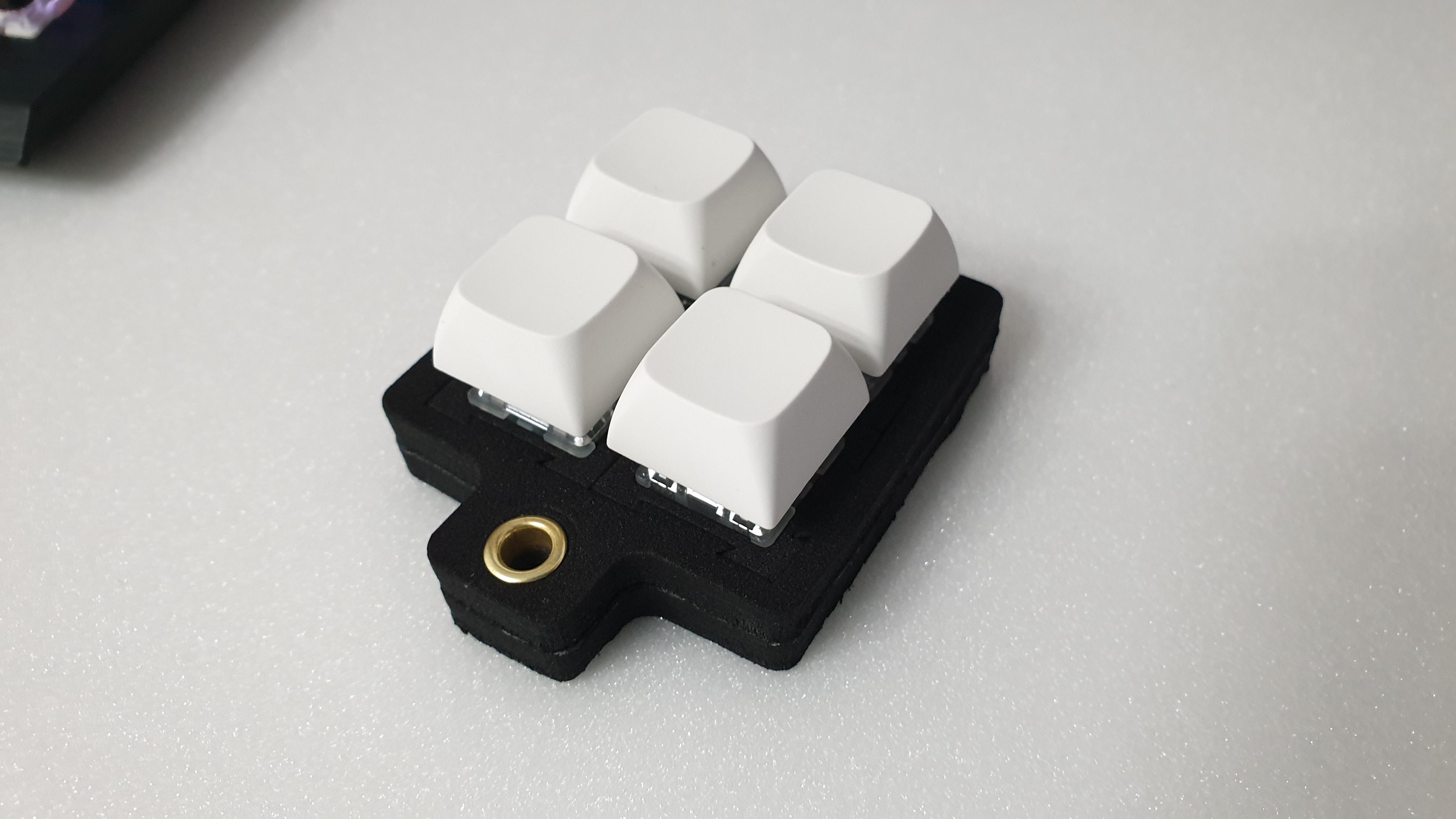


This modular clicker is perfect for:
- Kids’ handmade gifts
- DIY maker projects
- Beginner laser-cutting projects
With just the SVG files, users can fully customize:
- Colors
- Layouts
- Keycaps
The puzzle-style design allows endless rearrangement and adds a playful twist to a simple clicker.
One important thing
I learned while making this clicker is how much the material affects the sound.
When the housing is made from hard materials such as 3D-printed plastic or laser-cut acrylic/wood, the click sound often becomes too sharp and harsh.
This happens because hard materials reflect high-frequency sounds instead of absorbing them.
The reason EVA foam works so well is that it acts as a sound-absorbing material.
It softens sharp, high-pitched noises and turns them into a gentler, more pleasant click.
Even if you decide to make this clicker using other materials, I strongly recommend adding some form of sound absorption where the key and the housing come into contact.
A small layer of soft material can make a big difference in sound quality.
👉 In my experience, good clicker sound is not just about the switch—it’s about absorption.