Mini Tree Holiday Decorations (recycle Your Christmas Tree)
by reeddyer1 in Workshop > Woodworking
106 Views, 0 Favorites, 0 Comments
Mini Tree Holiday Decorations (recycle Your Christmas Tree)


These simple little trees are a great way to recycle last year's Christmas tree and make a cute and festive holiday decoration for your mantle or bookshelf. They are quick and easy to make and no two are the same.
Supplies
Last year's Christmas tree. (or any small trunk or branch, ideally with the bark still on)
Bandsaw (also possible with a jigsaw, but a little more challenging)
Safety glasses (of course)
Painter's tape (not really necessary)
Handsaw
Fine sandpaper (optional)
Prep Your Old Tree


As soon as you take down your Christmas tree, remove all the branches. I use a branch lopper but you could use a small saw or hatchet.
Ideally let the tree dry for several months. The longer the tree is allowed to dry the less sap you'll need to deal with and the easier and cleaner it will be to cut. If you're patient, you can trim the branches off in January, stash the trunk away, and come back to this project the following November. (Or do it all in the same day - it's your project.)
Cut Base to Height of Trees


You can make tress of any height, but I recommend trees between 8" and 16." Consider the diameter of the wood you are using and how tall they can be without looking too skinny or being unstable.
Here, I cut one at 10" from the base (for 2 trees at 10" each) and one at 8" (for 2 more trees at 8" each)
If you are using a bandsaw (which I did), it will be easiest to cut the trees if the height is less than the distance between the blade and the column of the bandsaw, but it's not essential.
You can cut as many sections as you like for additional trees, although as you work up the tree, the trunk will get thinner and cutting out the trees will require more precision.
Trim Branch Nubs Off Cleanly


The trees will be much easier to cut and move on the bandsaw if the branch nubs are cut off as close to the trunk as possible.
Cut Wood Down the Center


Cut the section in half as cleanly and straight as you can.
Mark Mid-line of the Trees

Marking the mid-line makes it easier to gauge how far in to cut each of the branches and to keep the tree a bit more symmetrical. I just use a strip of painters tape, with one edge running down the middle of the wood.
Cut the Branches on One Side of the Tree


Place the cut side of the wood flat on the bandsaw table. As always, use proper eye protection and safety procedures when using the bandsaw.
Start at the top of the tree right at the mid-point. Cut down and angle out to make the top swoop of the tree.
Then, just below where the top swoop ends (at the point of your top 'branch') cut in and up, following the swoop of the first branch up slightly cutting in almost to the center line.
Continue the same pattern for each branch, working down the tree.
Cut Base


Once you cut the final branch, finish the trunk by cutting in and up from the base.
The sample picture has a lot of branches that go most of the way down and a short trunk, but it also looks good if you have fewer branches and a longer trunk. Go ahead - experiment.
Cut Branches on Other Side of Tree


Remove the tape and mirror the process on the other side.
Be careful not to cut so far into the other side that you lop your tree in half.
Also, don't worry about being perfectly symmetrical. The left and right branches don't have to line up perfectly for the tree to look great.
Lightly Sand Back of Trees

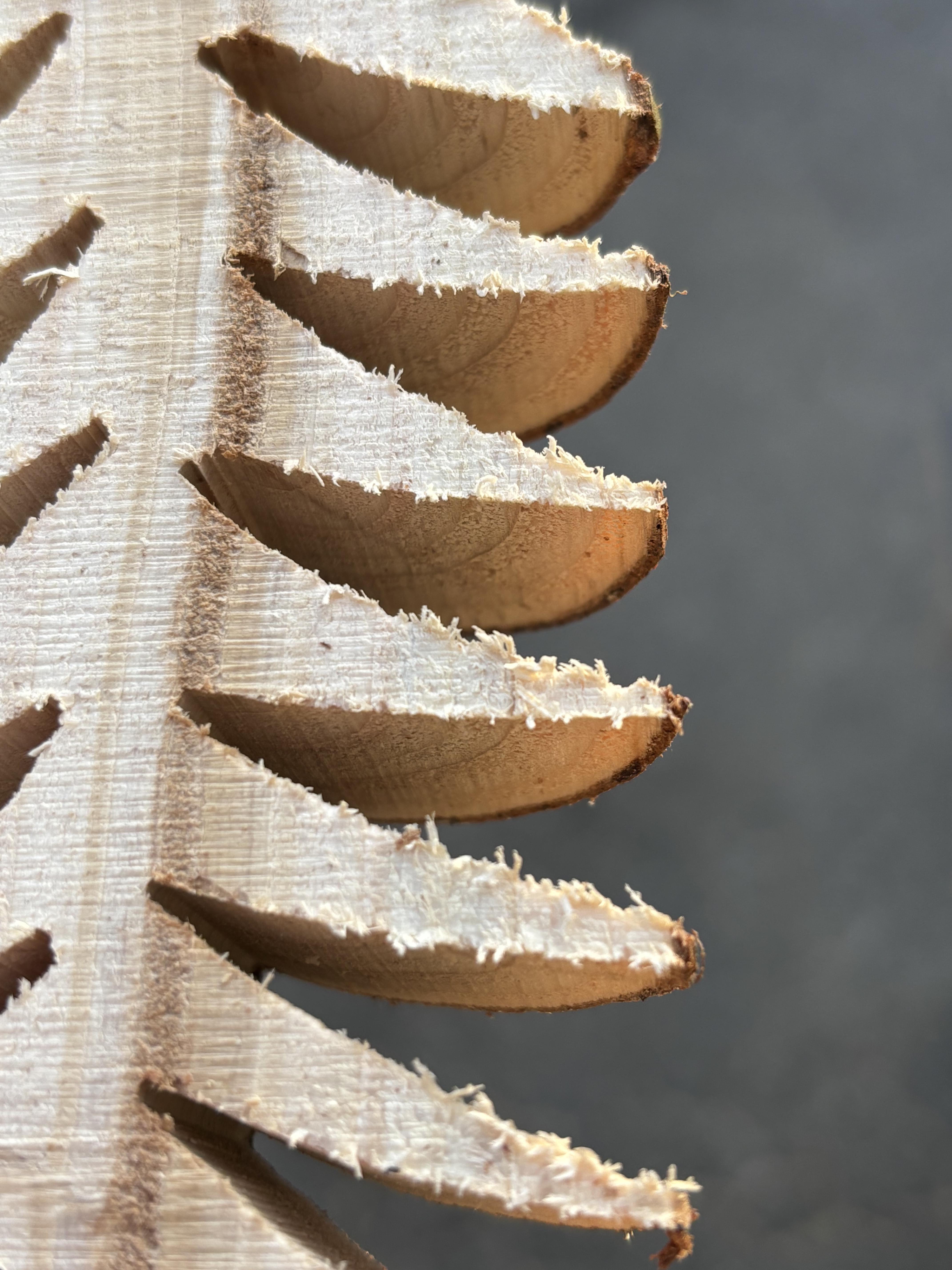

I recommend gently cleaning up the cut side of the tree by lightly sanding. The 'branches' can be delicate so I would not use a power sander or apply much pressure. Since the cut side is the 'back" this won't really be seen, but it's good to clean it up a bit.
Repeat Process for Other Trees


If you make multiple trees, have fun with how angled the branches are and how large the gap is between them. I like to keep the branches pretty close together, but it can also look great to just have a few on each side with "thicker" branches with a more angled swoop.
You can also lean into the unique elements of the wood you are working with. Notice that the two shorter trees pictured here have tops that point off at an angle. That section of trunk curved at the top, so I kept that curve in the final trees to give them a look of being blown by the wind.