How to Make a Single-Coil Motor
by science_kid in Circuits > Reuse
236 Views, 2 Favorites, 0 Comments
How to Make a Single-Coil Motor
If you like to see things spin, then this little motor will be perfect for you. This finished project can be used to better understand how electric motors work or as a fun desk toy. This project is very easy to make, and with a little fine-tuning after it is built, it can run for over five minutes by itself. I used an old USB charging cable to power it, which worked well, but a 1.5 V battery also got the job done.
This is a video of the motor in action.
Downloads
Supplies
- Two clothespins (The kind that has a metal spring in it)
- A plastic container that has little to no lip and that has vertical walls
- About 10 feet of magnet wire (this can be found in transformers and in motors)
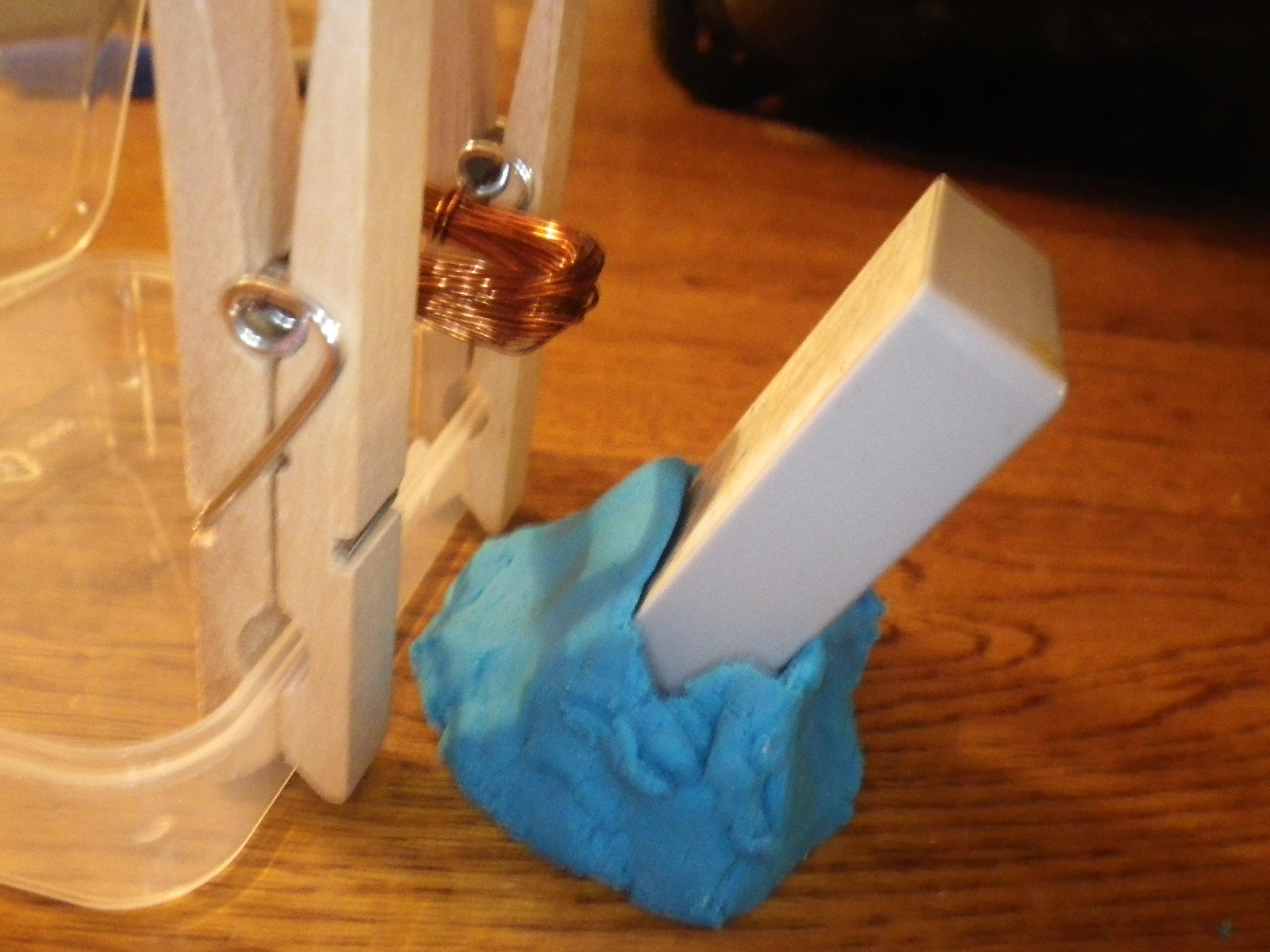
- A magnet that has its two poles next to each other. (you can use a horseshoe magnet, but two square magnets laid so that their poles are next to each other where the north of one and the south of the other are facing up. It should look something like what the picture at the top is)
- USB cable that has one end removed, leaving stripped wire at the end (The red and black wires are positive and negative, respectively)
- Two alligator clips or wires (the alligator clips make it very easy to connect everything, but are not necessary)
- Play Dough or modeling clay
- Tape (optional)
- Sandpaper
- Marker
Making the Coil


First, wrap the wire around something to give it a good shape. What I found is that a nine-volt battery works best, but a marker can work too. The nine-volt battery works better because it is slightly longer in one direction than the other, which increases the torque due to the magnetic fields being able to exert more leverage on the coil. Unravel about an inch from both ends of the coil.
Next, wrap the ends around the coil in such a way that they are on opposite sides and so that they keep the coil from falling apart. This is seen in the second picture above.
Then, strip the enameling off the unraveled ends of the magnet wire using 100 grit sandpaper. This can also be done with a knife.
Now, on one of the wires sticking out of the coil, use a marker to color on one side of the wire. This stops the electricity from flowing half of the time, which is important because when the coil reverses, it doesn't start going the other way.
Putting the Frame Together

This next step is to put the two clothes pins on the side of the plastic container as shown in the picture. the magnet is then put in the play dough at an angle.
Putting Everything Together

Attach the alligator clips to the free wires of the USB cable. Then, put the coil into the holes of the spring from the clothespins. Make sure that the wires from the coil are are as straight as possible so it doesn't bounce around too much. Now, attach the alligator clips to the metal spring in the clothespin, making sure that they don't interfere with the motor spinning. If you are using a battery, then tape the wires to the battery, and tuck them under the spring to stay in place. To have a quick disconnect, then fasten the wire with tape on one side.
Starting the Motor
To start the motor, plug it into a USB port and give the motor a little nudge to get it going. The motor will spin surprisingly fast, and is fun to watch, but if it is run for more than about two minutes, it gets almost too hot to touch, so it is probably a good idea to not leave it powered on while unattended. It may smoke or even catch fire at higher voltages, so it is not recommended to run it from more than five volts. To improve the performance, try moving the position of the magnet in relation to the coil, and see where the "sweet spot" is.
You have now make an electric motor!