Differential Amplifier, MiniPCB, 04B-358, Rev A1-03
by miniPCB in Circuits > Electronics
37 Views, 0 Favorites, 0 Comments
Differential Amplifier, MiniPCB, 04B-358, Rev A1-03


I made a differential amplifier with a gain of approximately 24! ... which sounds really low to be honest. So I'm considering lowering the 100k to 22k. I'm probably not biassing the transistor strongly enough.
Yup, I changed the 100k to 22k, adjusted the trimmers, and now have a gain of approximately 45! Much better.
This circuit only outputs a single end of the differential output. The differential gain is approximately double.
Collect Components


The PCB is a two layer board, and designed to be easy to manufacture and assemble. And it is optimized for cost by being panelized on 100 x 100 mm squares.
Signals are routed on the bottom layer (the layer with the part number), and a common ground plane (as uncut as possible) is on the top layer.
The P1 connector is located in a standard position with respect to the board edges: making it possible to build a universal tester, backplane, or stand.
Solder Components


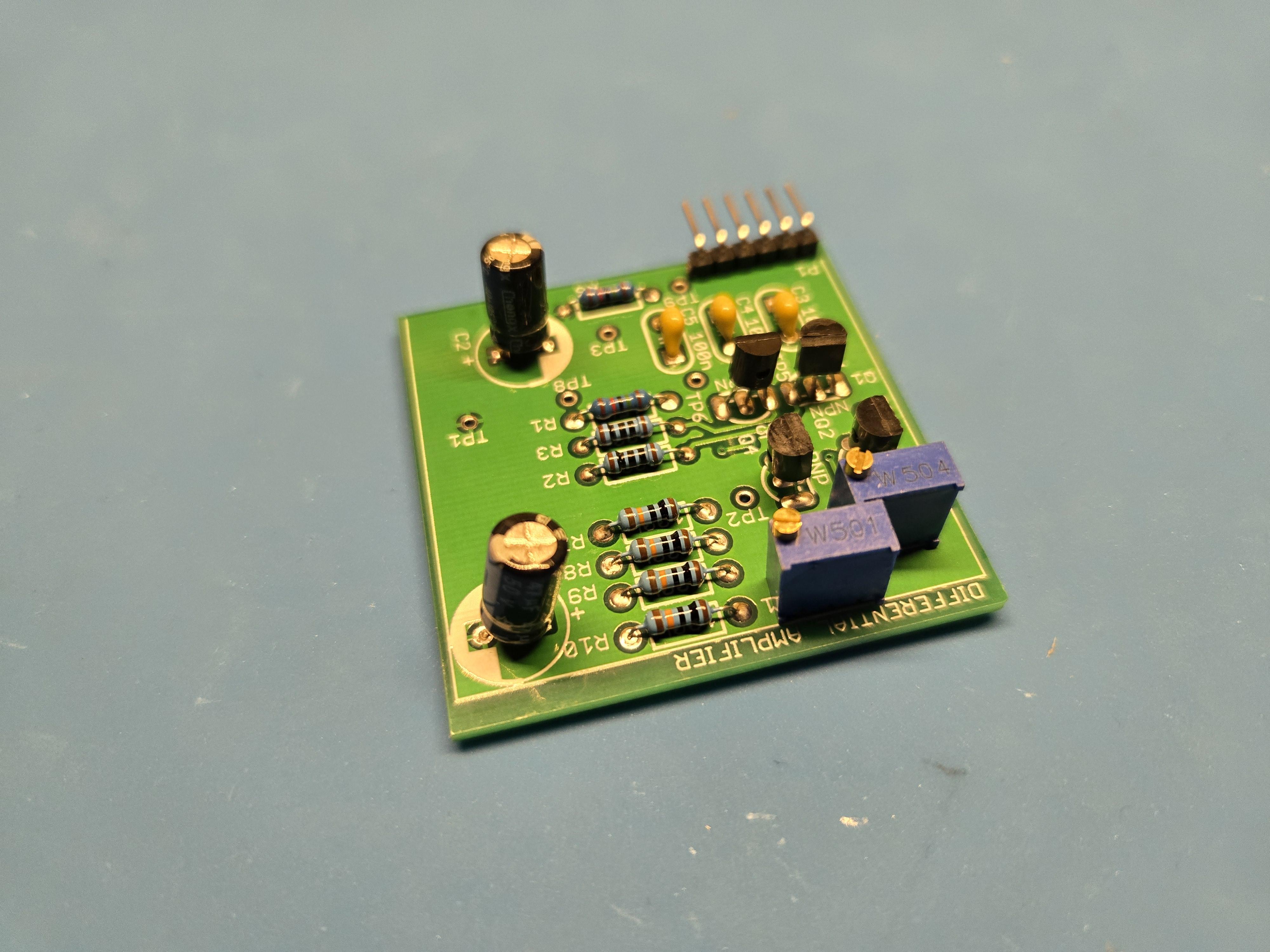


For ease, start with the shortest components.
If a potentiometer is installed with pin 1 in the wrong place, the adjustment procedure will be inverted (CW/CCW).
Test With Digilent's Analog Discovery 2/3


For ease of changing between five-pin boards, use Interface Board, 00A-12.
Optimize Biasing Resistors


By making R4 (trimmer/potentiometer) 1k times larger than R5 (trimmer/potentiometer), we have a coarse and a fine adjustment. Since the incorrect values are on the schematic and silkscreen, the schematic and board will rev from A1-03 to A1-04.
Calibration Procedure
Apply +5 V and -5 V power.
Apply a sine wave with a 20 mV amplitude to the amplifier inputs.
Adjust R4 such that TP4 is approximately 0 V.
Adjust R5 such that an optimal sinewave is seen at TP9. This may be CW or CCW depending on where R4 is set.
If no optimal sinewave is possible, adjust R4 such that TP4 is closer to 0 V and retry adjusting R5.