Creative Chaos - a Wooden Tree Sculpture
by rschoenm in Workshop > Woodworking
3601 Views, 21 Favorites, 0 Comments
Creative Chaos - a Wooden Tree Sculpture

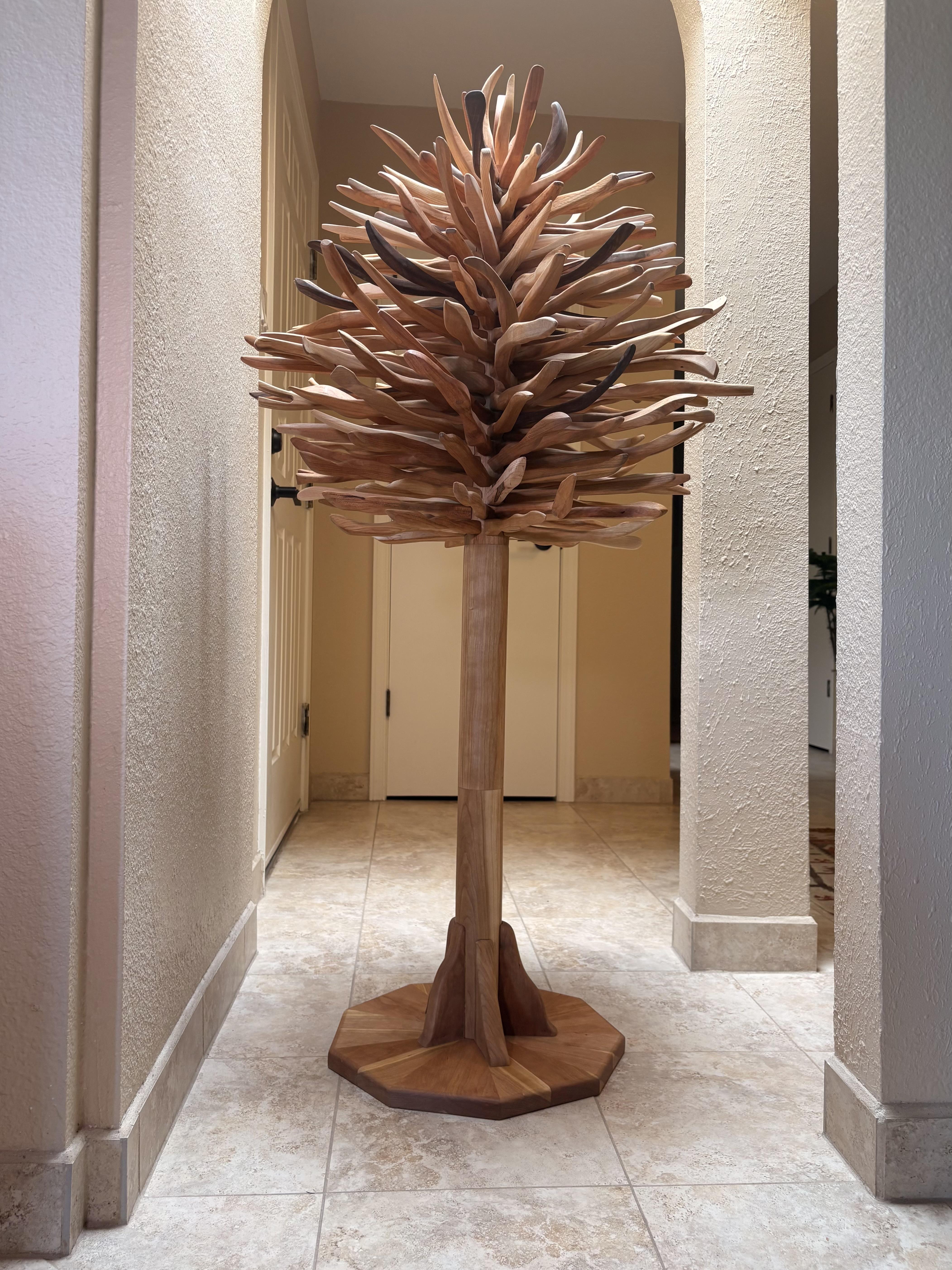
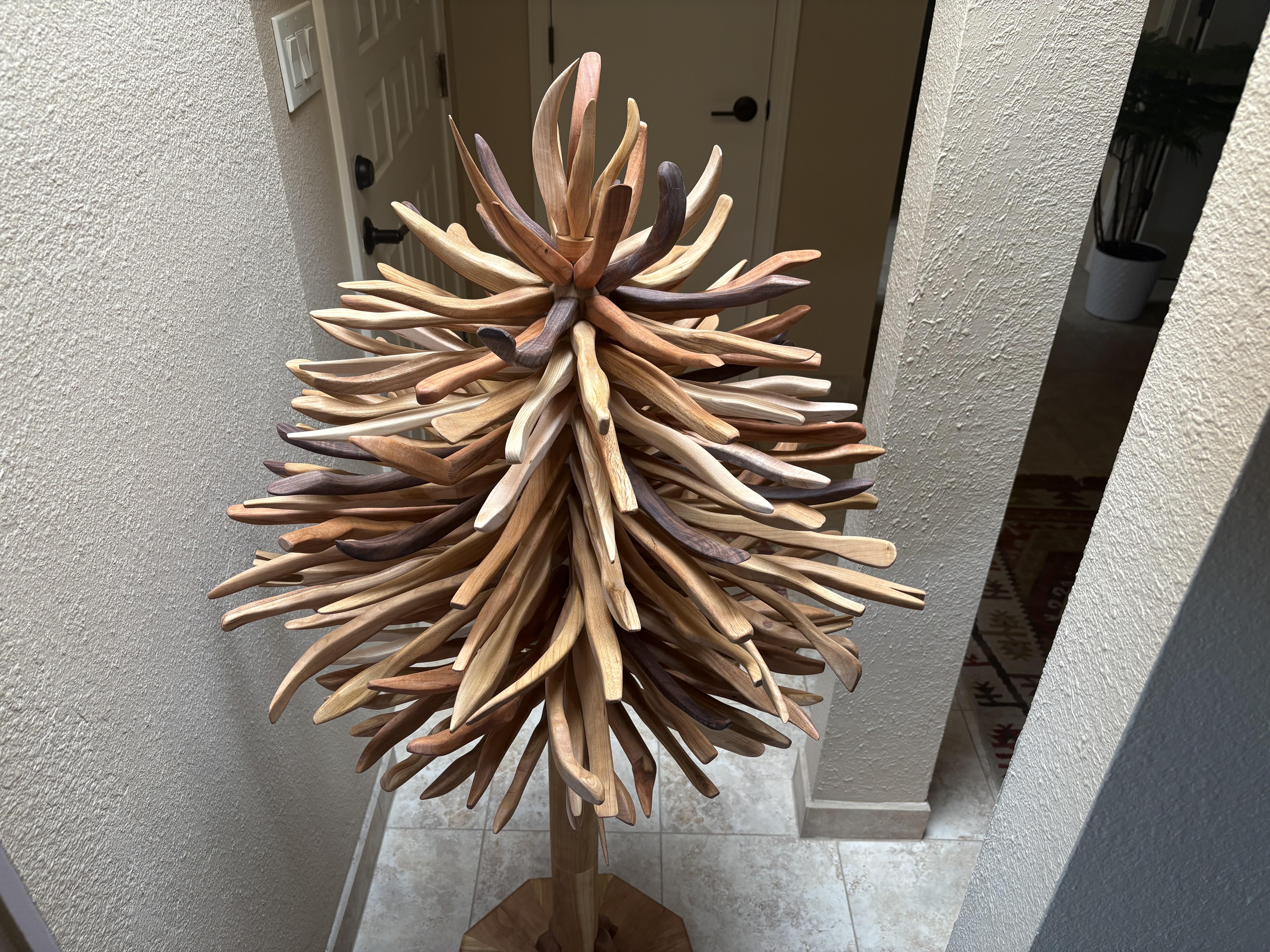
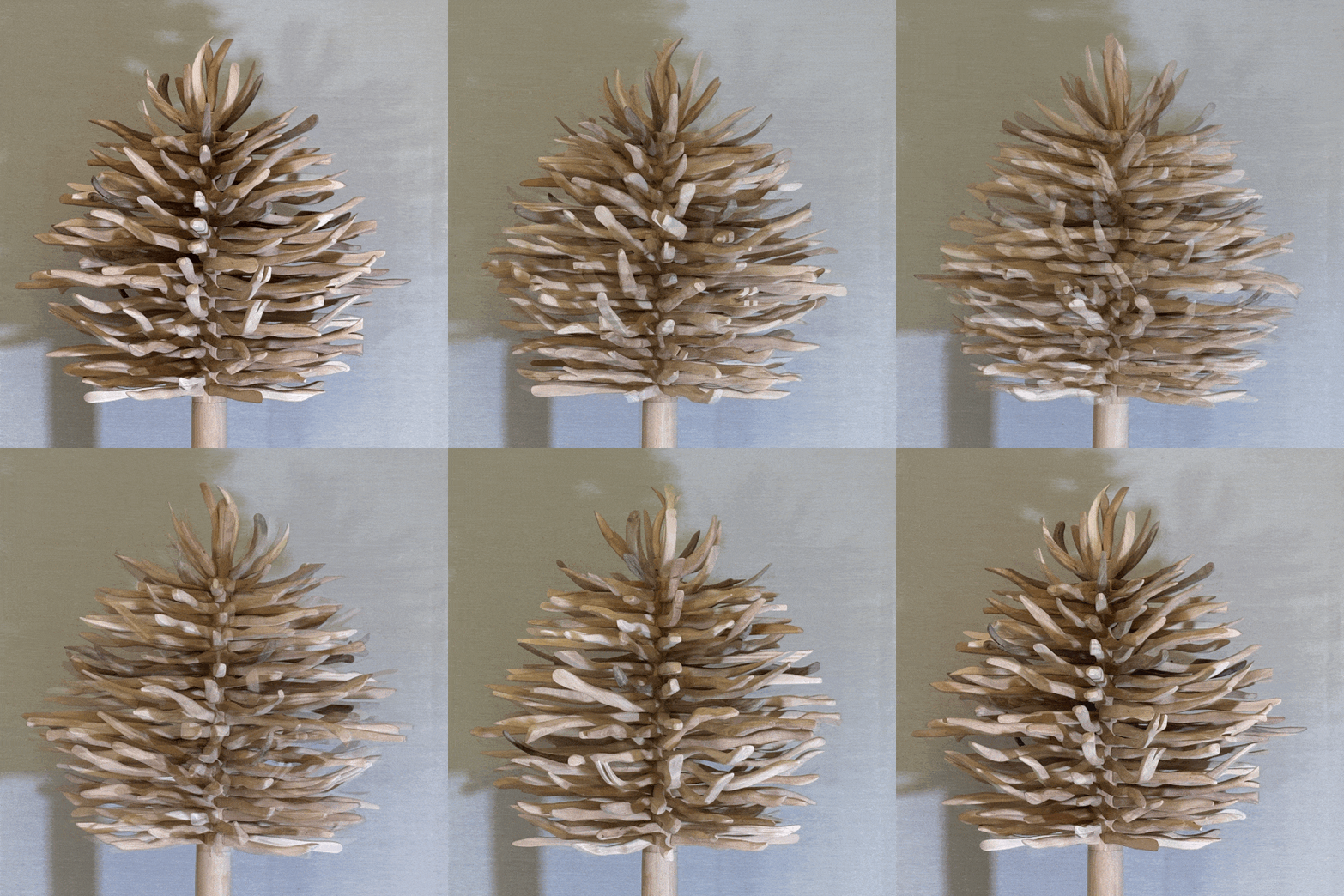


The four year old Norfolk pine at my entry way looked very sad. Due to the lack of light the once lush green indoor tree had lost many of its lower "branches" and needles. It was time to replace it. How about making a sculpture, shaped and carved from pretty hardwoods, to resemble a tree? Here is my journey in creating it.
The inspiration for this sculpture came from a visit to the Chihuly Garden and Glass Museum in Seattle. I decided to make a sculpture similar to some of the Chihuly art pieces but using wood instead of glass! My finished sculpture is 57” tall overall, and the "branch" canopy is about 26” in diameter at its widest. Materials I used are various cut-offs and leftover pieces of cherry, maple, walnut, and some exotic woods.
I choose to call the sculpture “Creative Chaos”.
Before I tackled this project I made a prototype cut from cedar fence planks, see the last picture above. The prototype is now displayed in my backyard.
Supplies
Cherry, maple, walnut, and other hardwood pieces, 3/4” thick and up to 13” long. Cut-offs work well.
Cherry wood for the base and trunk
3/8” and 3/4” hardwood dowels
Lots of 100 grit sandpaper
150 and 220 grit sandpaper
Wood glue
Hot melt glue sticks
Tools:
Band saw, lathe, drill press, power drill, DIY sanding pads for power drill, glue gun
The Tree Trunk

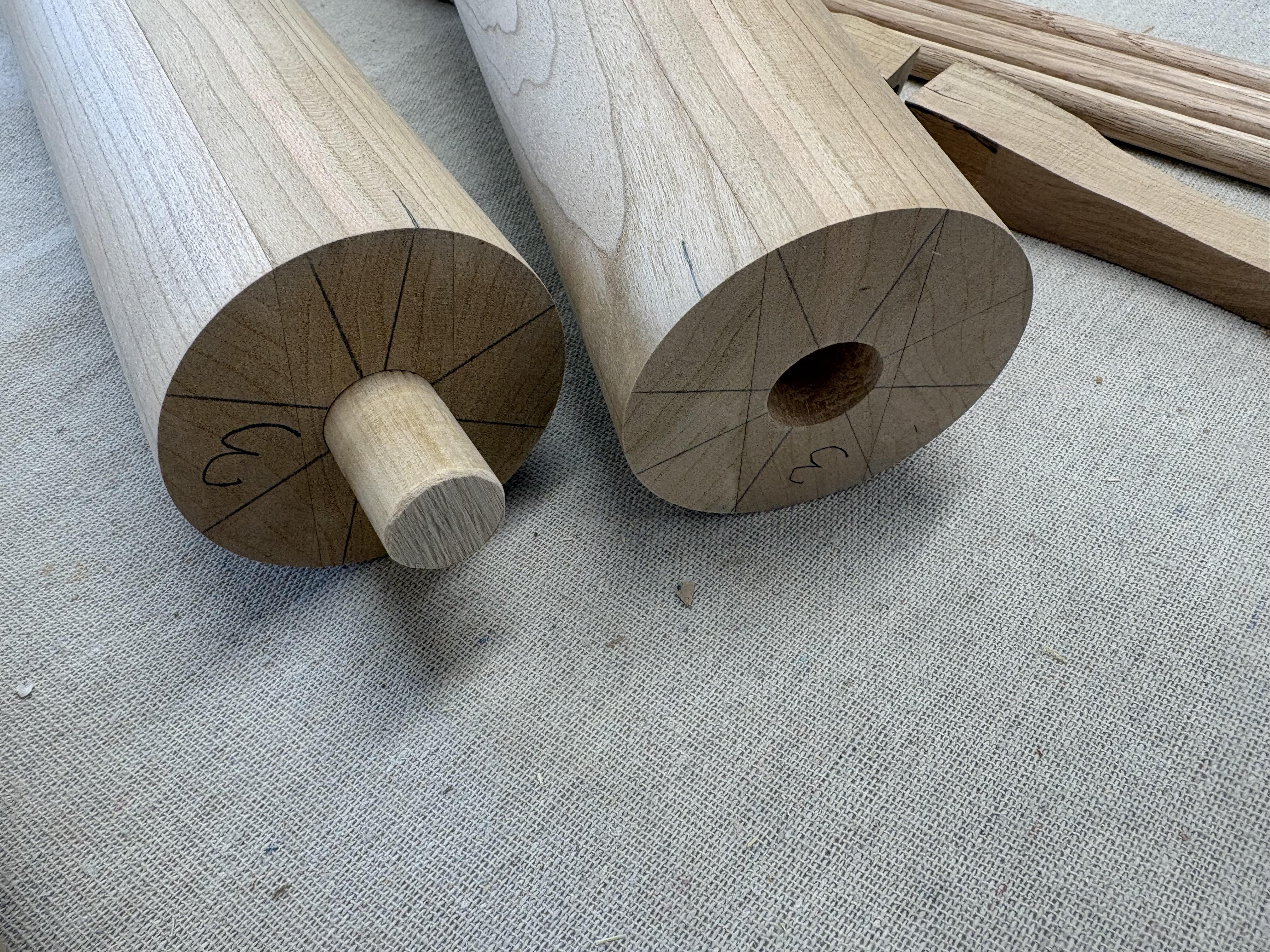


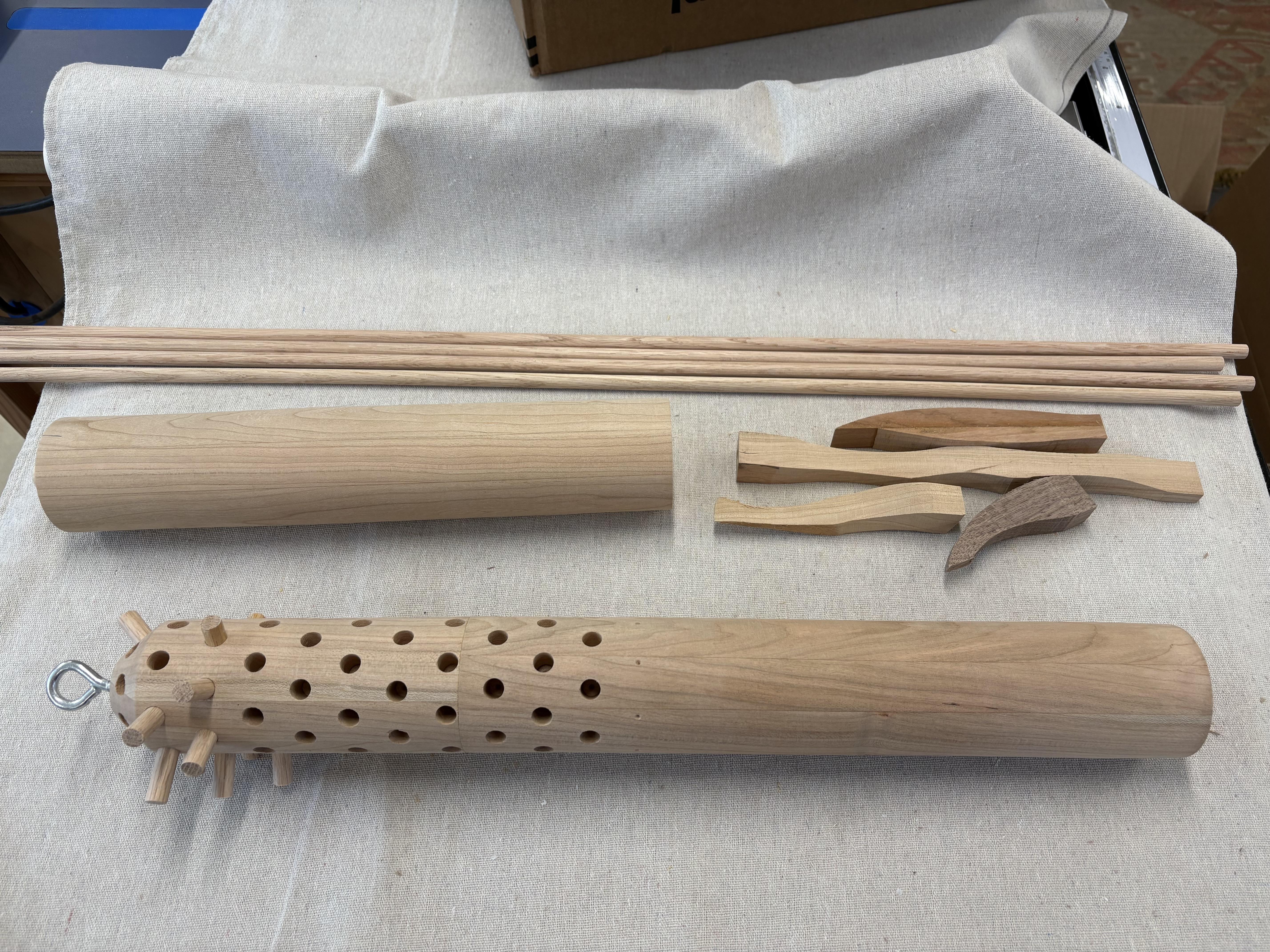
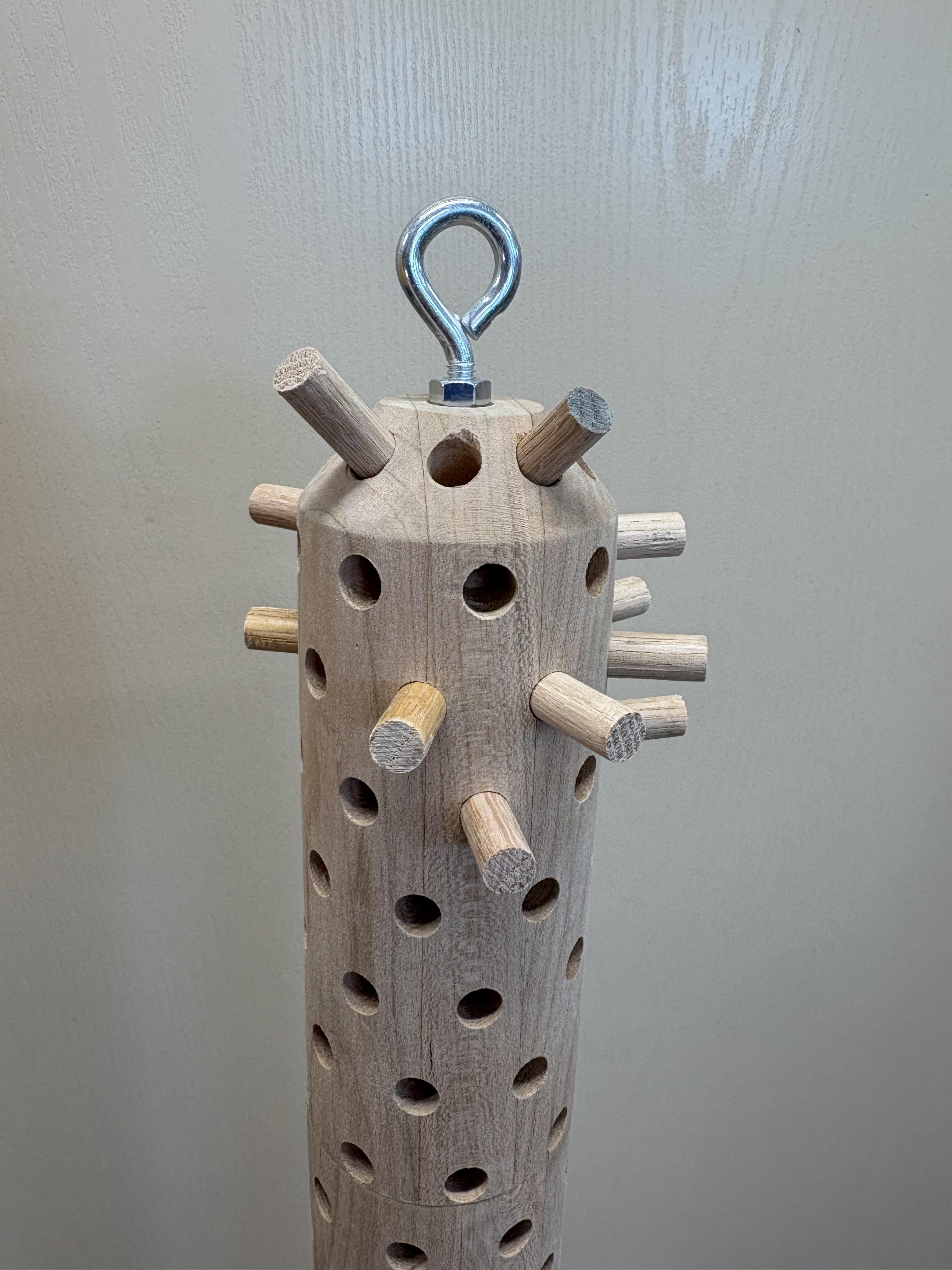
The tree “trunk” is made on the lathe. After gluing up blanks I made four round pieces 2.6” (66 mm) diameter and about 14” long. The top section holding the "branches" is 21” long and was glued end to end before drilling the holes for all the “branches”. A 3/4” short dowel piece secures and strengthens the joint.
I wrapped the printed template (see attached PDF file "Hole Spacing" for a 66 mm dia round) around the top section, taped it down to secure it, and marked the drill holes. There are 8 holes around the perimeter of the “trunk”. I repeated this four times until I had marked 22 rows of 8 holes each. My tree has 176 “branches” plus the arrangement on the top.
At the drill press I mounted a v-grooved board to center the round top section while drilling the holes; it helps to keep it in place. All holes were drilled with a 3/8” Forstner bit and drilled 15 mm deep. These holes are for dowel joints to attach the “branches”.
At the top I put in a 1/4" threaded insert for attaching an eye bolt. This comes in handy when lifting the heavy sculpture for moving it. The bolt can be removed and replaced with the "crown", see Step 5 later on.
The other two pieces of the "trunk" are glued together end to end with a short 3/4” dowel reinforcing the joint. The complete "trunk" was glued up after drilling all the holes in the top section.
Downloads
Sanding Pads and Disks


For shaping the “branches” I made several flexible sanding pads/disks using packing foam. They consist of a small plywood disk, a 1/4” bolt and nuts, 1” or thicker packing foam, hot glue, and sand paper. These are easy to make, economical, and very useful for shaping the “branches”. I replaced (i.e. re-glued) fresh sand paper quite frequently. Essentially I am carving the “branches” with these rotating sanding disks. My Instructable for making sanding pads is here: https://www.instructables.com/Flexible-Sanding-Blocks/
The Branches


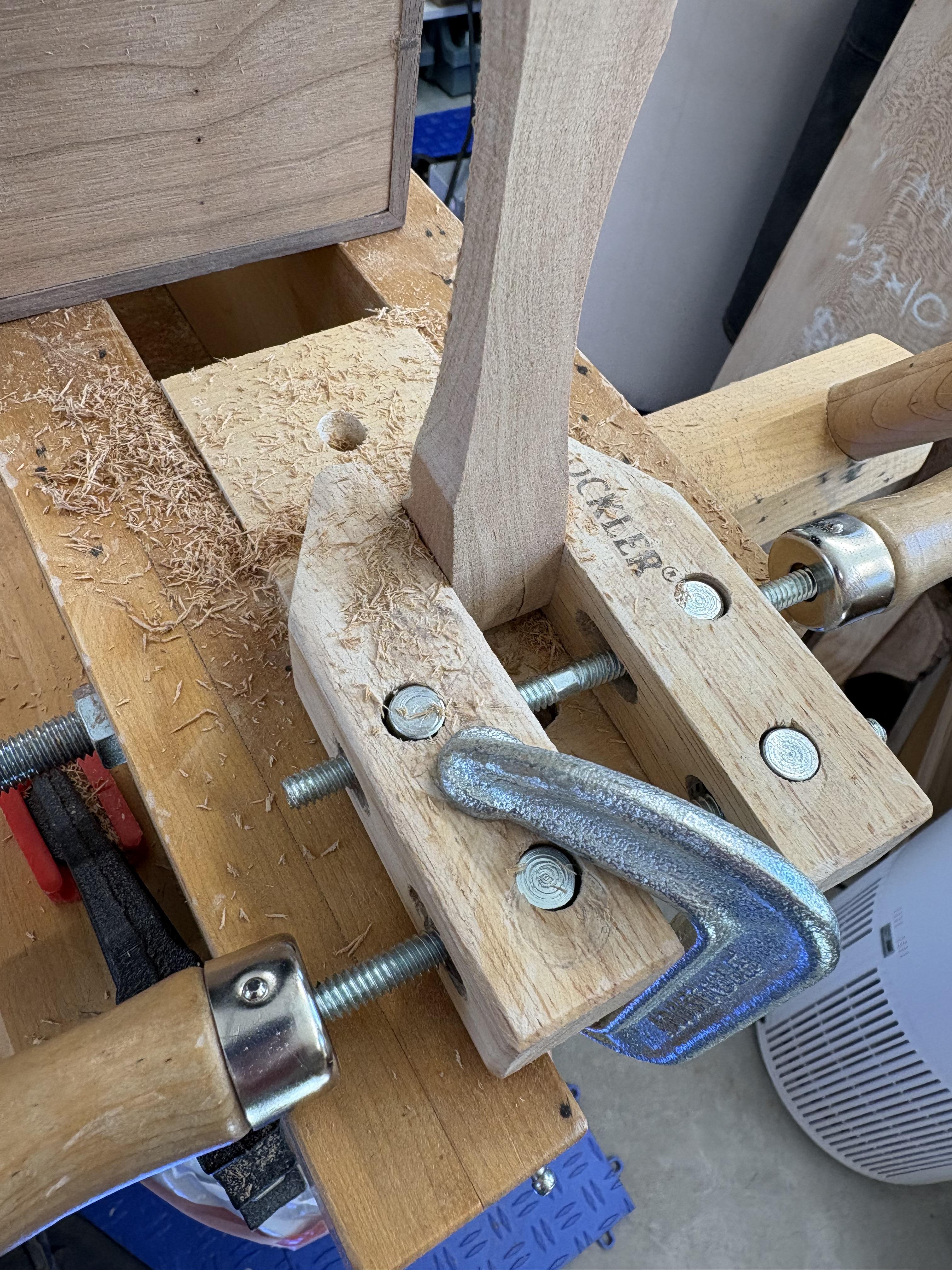


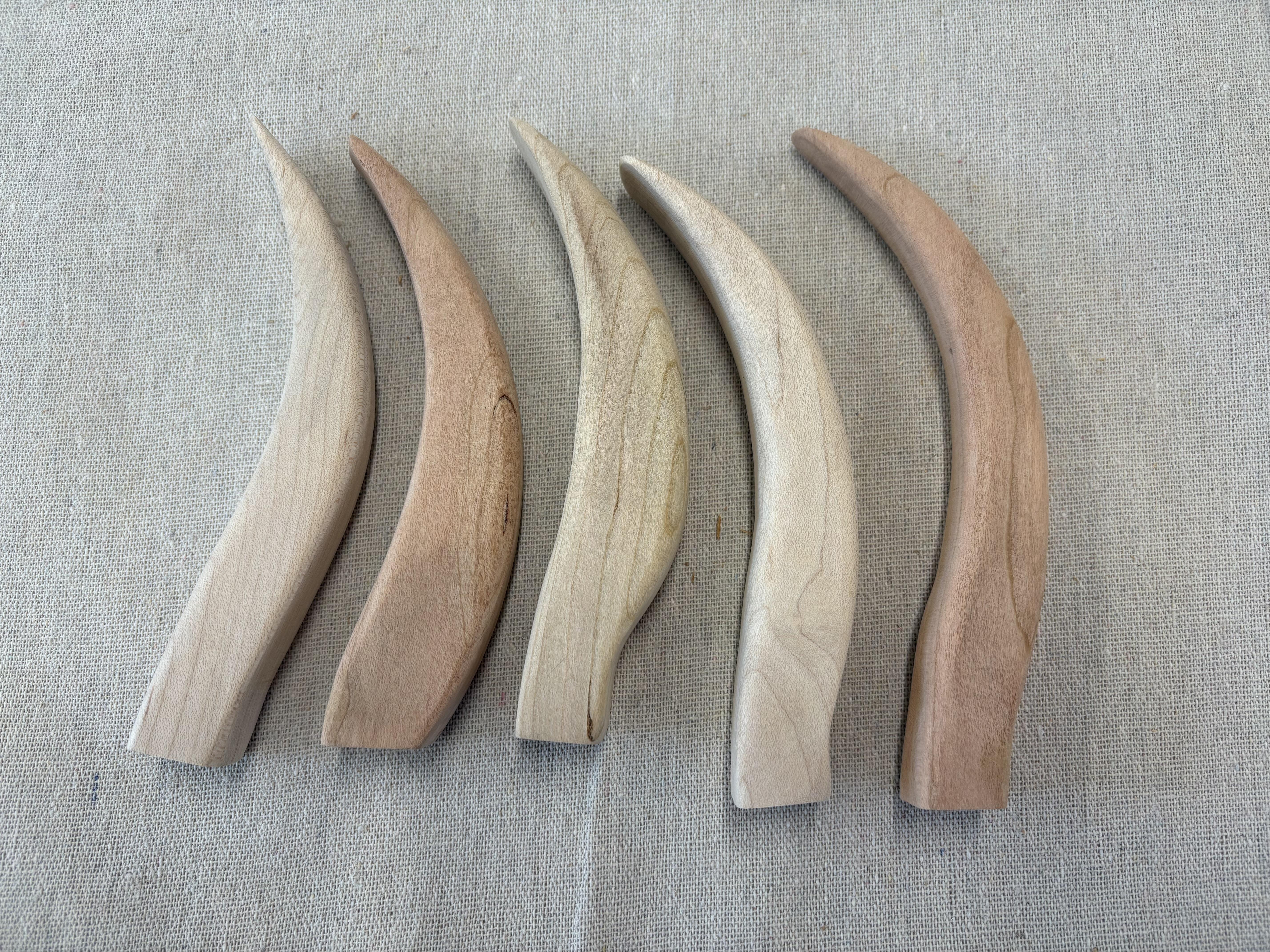

For my project I needed 176 “branches” to attach to the “trunk”. I wanted to create a tree canopy from these "branches" and have a large variety of shapes, lengths, angles, curvatures, and colors. Since I had a lot of cut-offs and short waste pieces in my shop this sculpture was a great way to put them to use.
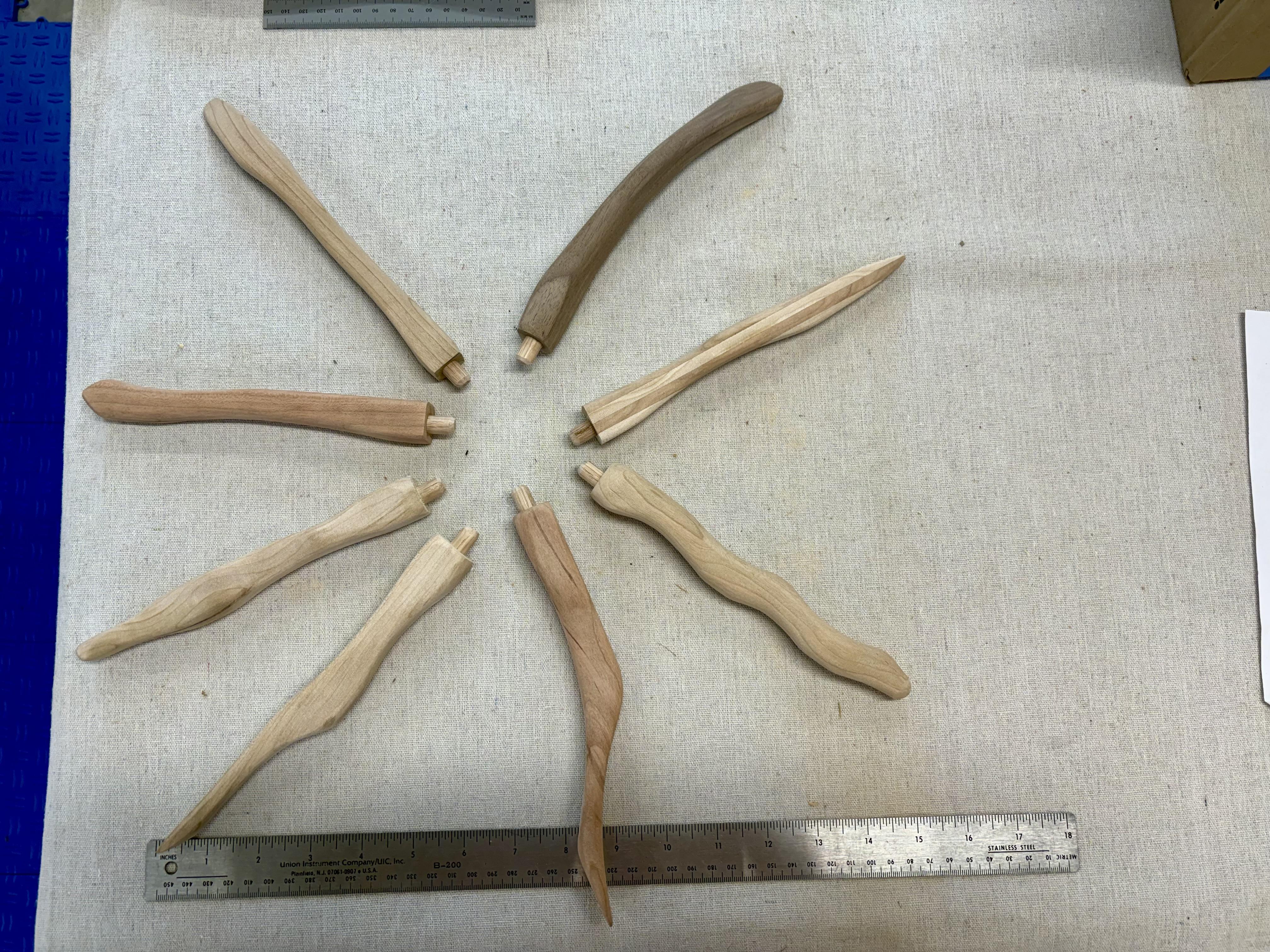
Most “branches” start out from a 3/4” thick board. Each “branch” was made like this: First I drilled a 3/8” hole into the end of the board, 1/2” deep. Then I shaped the “branch” by cutting free-hand curves along its length on the band saw. Next I rounded the four edges with a round rasp. The pictures and video show how I held the piece while I was working on it. Notice the dust collector port next to where I’m working. This project, especially the sanding will make a lot of saw dust.
To further round the edges and shape the “branch” I used two different techniques; both are shown in the video.
(1) I inserted my DIY sanding pads/disks in my hand-held power drill and worked the edges. I made sure the dust collector was mounted nearby and running.
(2) For an alternative (and generally faster) method of shaping the "branches" I used the sanding pads in my lathe.
To make "branches" with a curvature I started with a wide board, 10" wide by 12" long, and drew the curved shapes. Then I drilled 3/8" holes, 1/2" deep into the end of the board before cutting on the bandsaw.
The 176 "branches" vary in length from 6" to 13" long.
The Roots


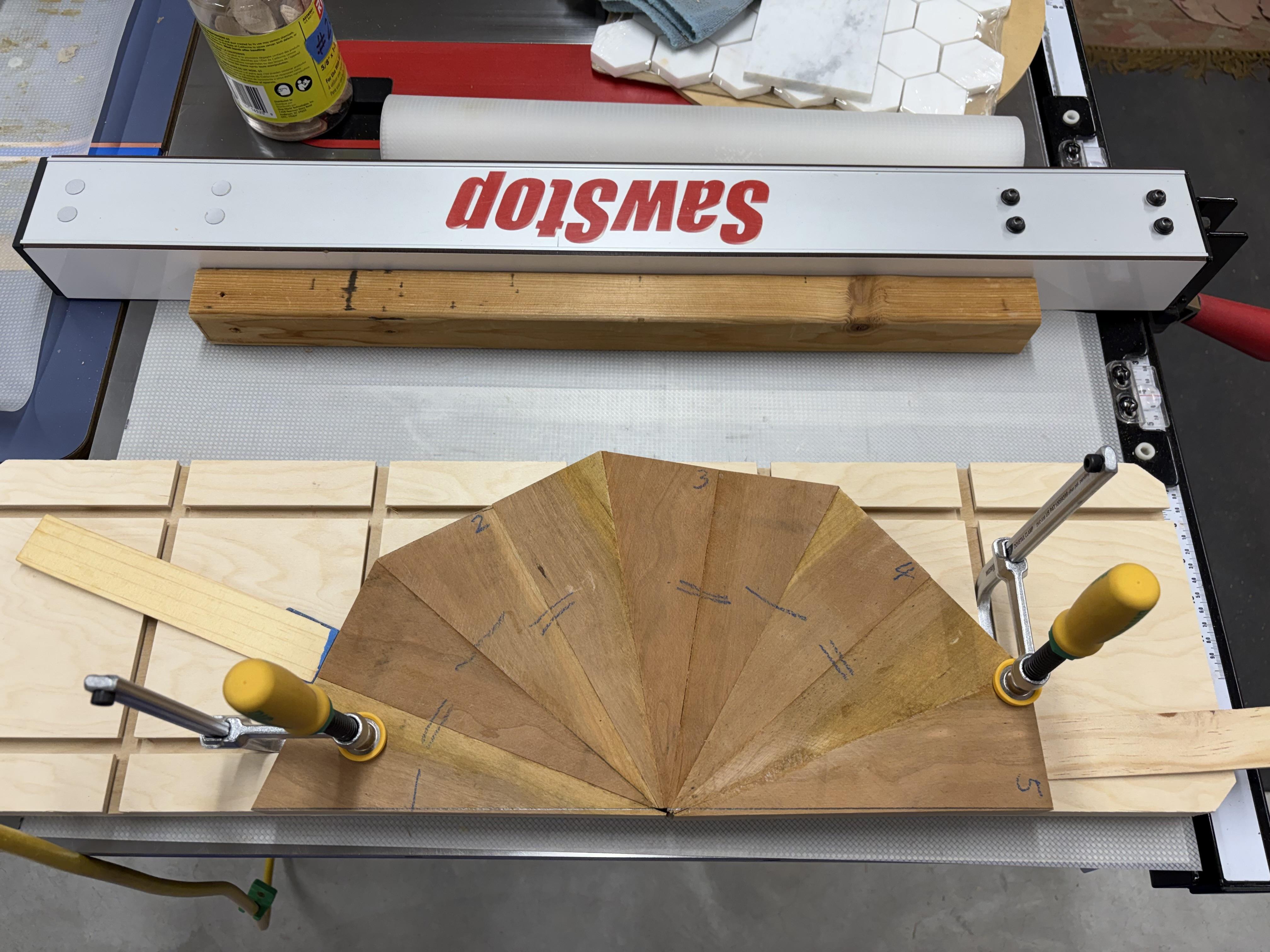


To mount and place the tree I made a 15" diameter bottom plate from 1" thick cherry wood. I cut the wood into 20 degree wedges and glued up the 9-sided plate (nonagon) in several steps. First I glued sets of two wedges together. After those had dried I glued up four-wedge pieces, then half a circle (180 degrees, i.e 9 wedges). This allowed me to make a straight cut along the center of the two half circles for a perfect glue fit. All joints were reinforced with #20 biscuits for alignment and strength.
Then I drilled a 3/4" hole through the center to join the "trunk" to the plate with a dowel. In addition, I cut five organically shaped triangles to attach to the "trunk" and bottom plate. I shaped these to resemble large exposed roots. They stabilize the "trunk", and are glued with 3/8" dowels to the "trunk" and attached with screws to the bottom plate.
The Crown


As mentioned in Step 1 I made a detachable "crown" for the top of the tree. It is a 1.25" diameter round piece about 1 inch tall with four 3/8" holes and one 1/4" center hole. I attached four short curved "branches" with 3/8" dowels to the four holes, and glued a 1/4"-20 threaded rod into the center hole. This allows me to mount the "crown" on top of the "trunk".
Putting It Together


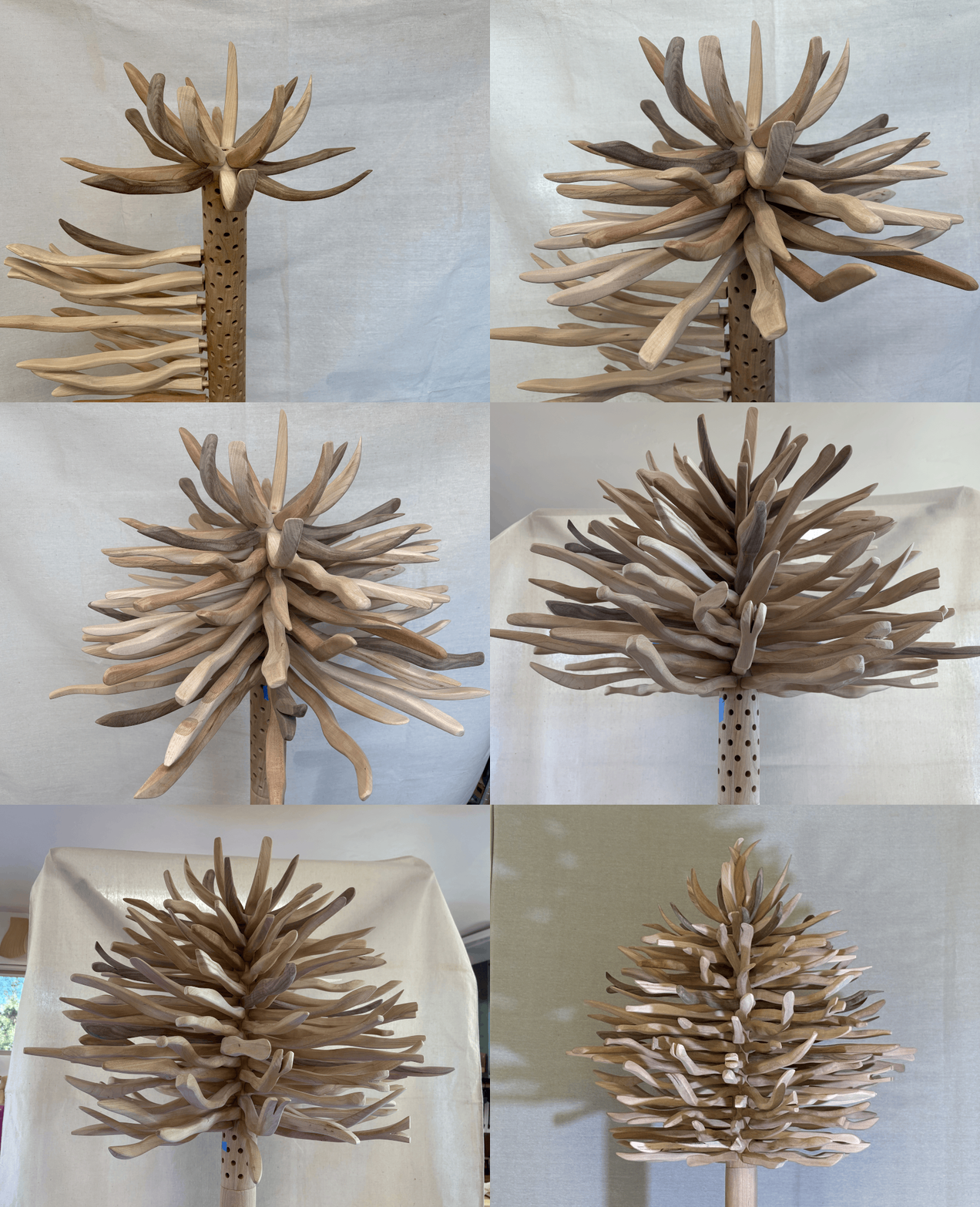


The "branches" vary in length from about 6” to about 13”. I decided to make the overall shape of the tree canopy like the sketch shown above. For this I needed to have “branches” with varying length like this: 16 x 6”, 24 x 7”, 32 x 8”, 32 x 9”, 32 x 10”, 32 x 11” to 12”, and 8 x 13”.
The “branches” were attached to the “trunk” using short pieces of 3/8” oak dowels and wood glue. Some of the curved “branches” were turned sideways for esthetic reasons or for a proper fit. I did some trials without glue to see what the finished tree might look like and made some adjustments.
Before I glued the "branches" to the "trunk" I laid them out for each row - eight at a time to balance shape, color, and curvature. I started at the top and glued in the eight 6" long "branches" around the "trunk". Then I moved down to the next row.
I had great help from my daughter in making "branches" and putting the final sculpture together; it was a lot of fun working together in my workshop!
Creative Chaos

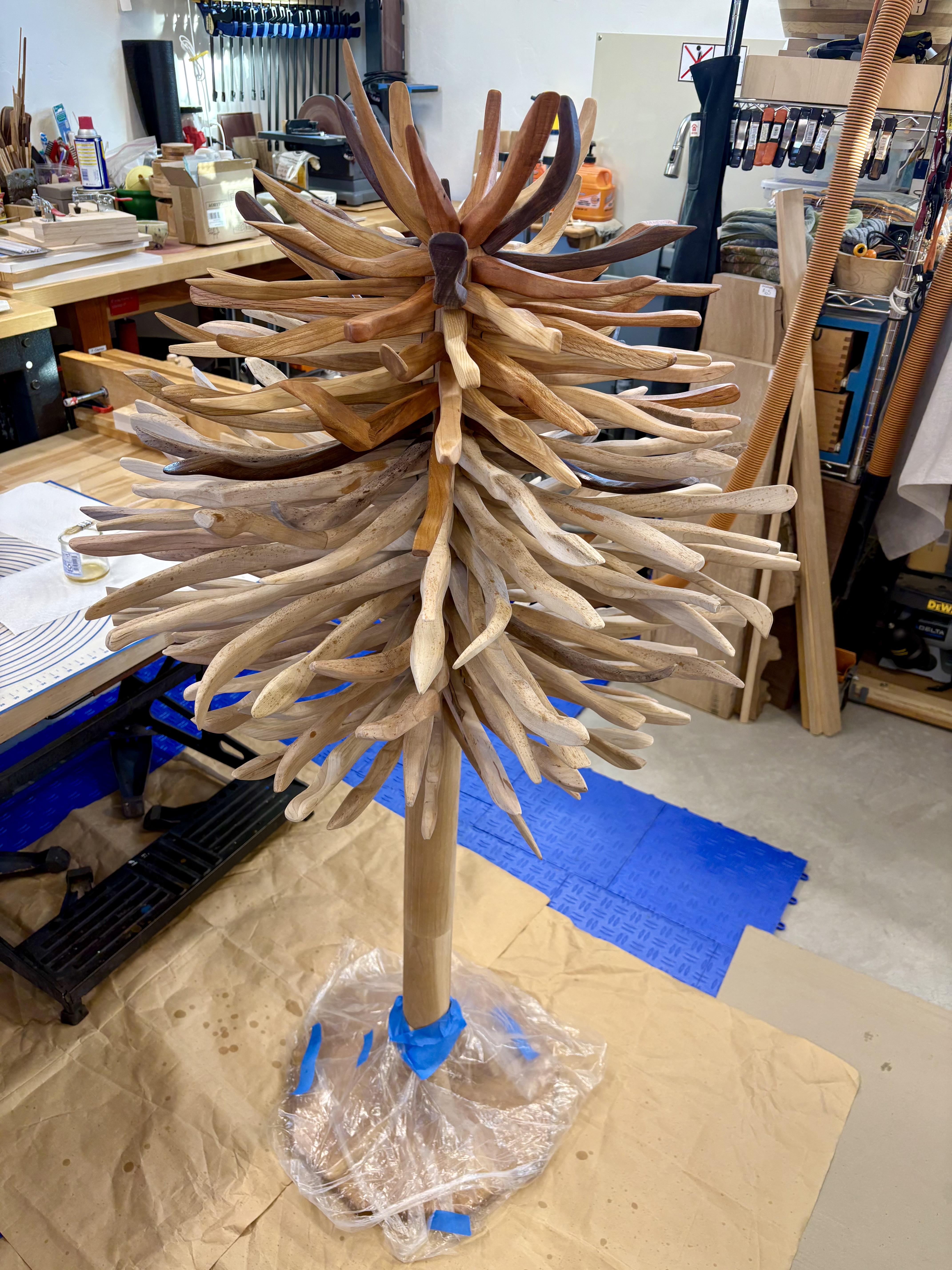


The tree sculpture was finished with a coat of natural color Danish Oil. I used a 1/2" wide brush attached to a 15" long dowel in order to reach the tight spaces between the "branches".
The finished sculpture looks great. I fits perfectly the space in my house for which I planned it. The project took a while to complete, it was not a weekend project.
For the Holiday Season my wife will decorate some of the "branches" with ornaments, just like a Christmas tree.
Since I involved my family in making some of the "branches" I think the title "Family Tree" would also be appropriate for this sculpture. Many other names have been suggested; including “Medusa”, “Blooming Onion”, “Tumbleweed”, “Chihuly in Wood”, "Octopus", “Random Thoughts”, "Trivial Drama", "Not A Coat Hanger", ….... You let me know what you think it should be named!